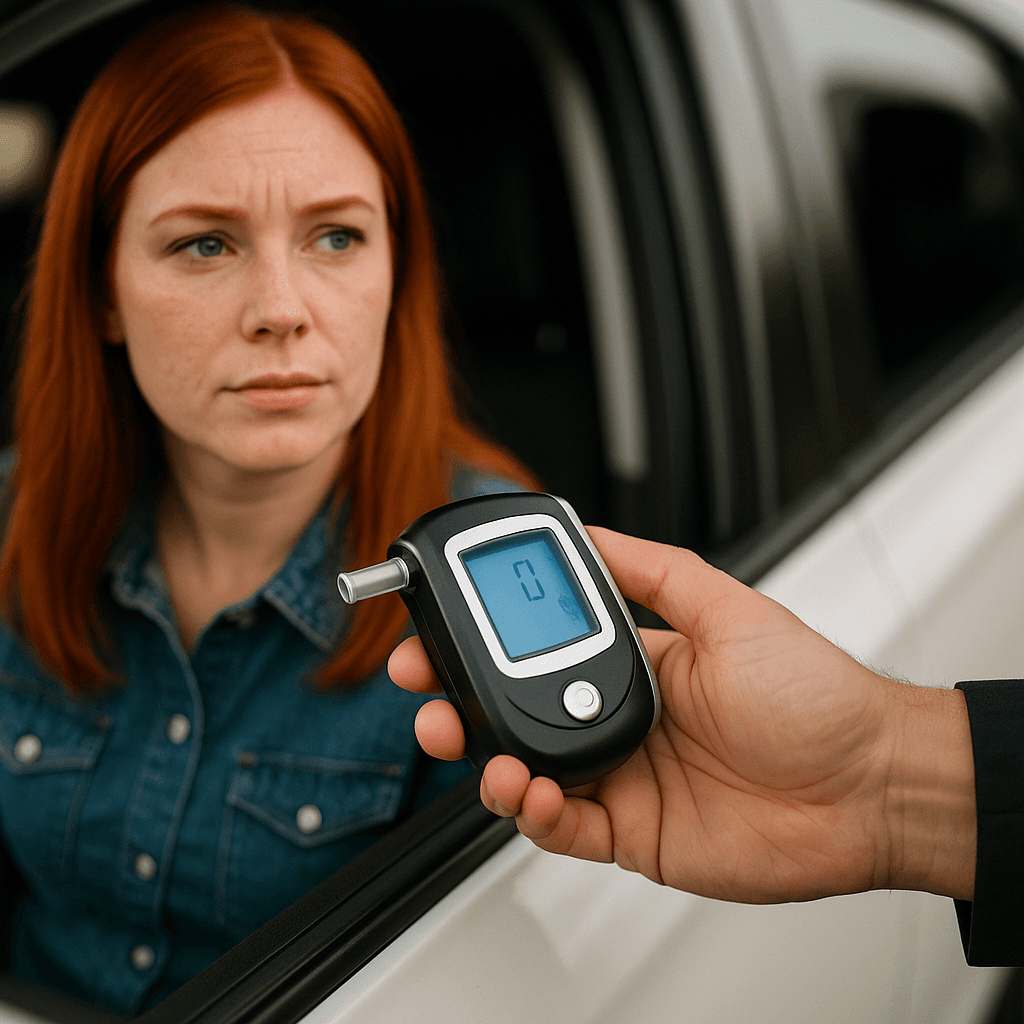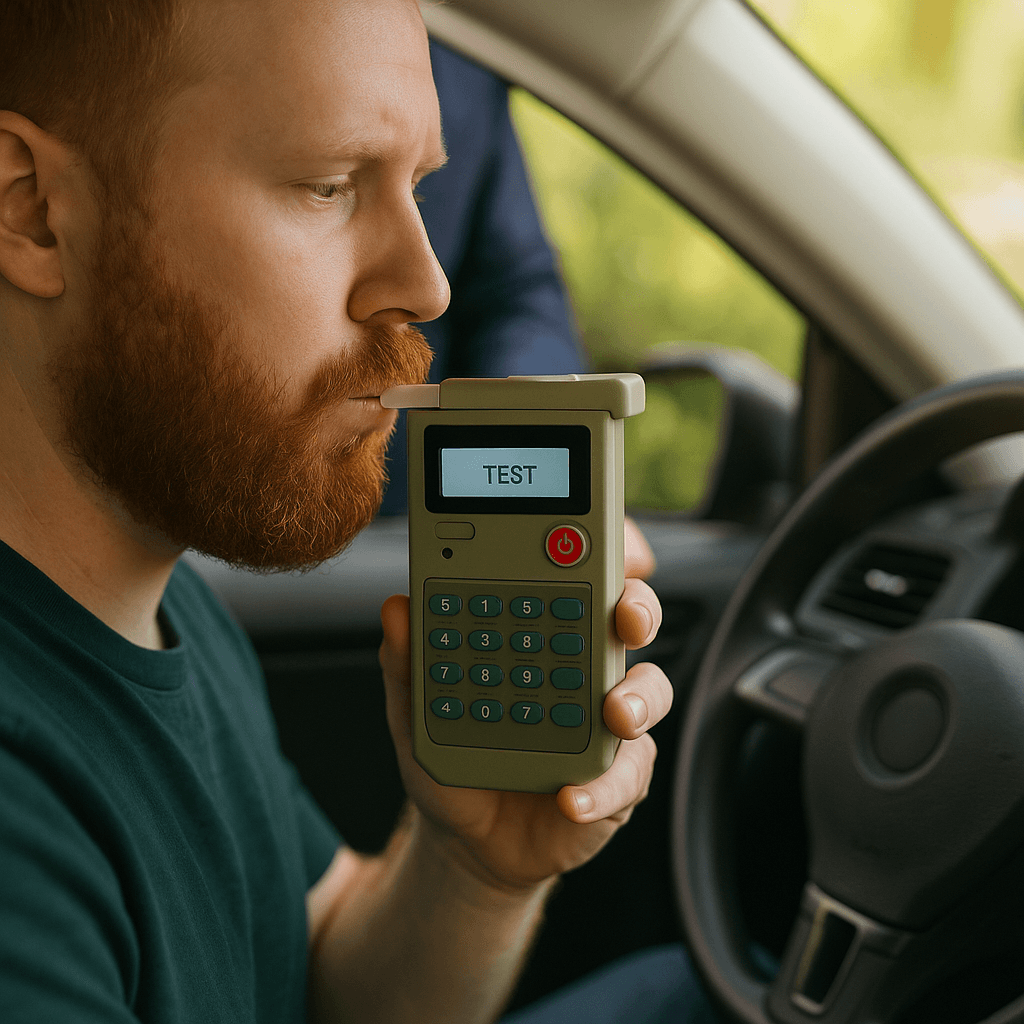
Your ignition interlock device locked you out during your hardship license period, and you're not sure whether the state already knows or how a lockout affects your restricted driving privilege. Most states receive violation alerts within 24-48 hours, and the consequences depend on whether the lockout was a rolling violation or a true failure.
What Triggers an Ignition Interlock Lockout During Hardship Driving
An ignition interlock device locks out when it detects alcohol above the programmed threshold (typically 0.02 BAC), when you miss a rolling retest while driving, or when you skip a required calibration appointment. The lockout is immediate: the vehicle will not start until you complete a successful breath test or the device enters temporary lockout mode requiring service provider reset.
Most state hardship license programs require ignition interlock as a condition of restricted driving after DUI suspension. The device logs every startup test, every rolling retest, every failed attempt, and every missed calibration window. Those logs transmit to the IID service provider, which reports violations to the state licensing agency under statutory timelines — usually within 24 to 48 hours of the event.
A lockout itself is not always a hardship license violation. States distinguish between rolling violations (a warn-and-clear event where you missed the rolling retest but pulled over, retested successfully, and continued driving) and true failures (startup refusal due to alcohol detection, repeated missed retests, or tampering). The classification determines whether the state treats the lockout as a reportable violation or a logged event with no immediate consequence.
How States Learn About IID Lockouts and What They Do With the Data
Ignition interlock service providers operate under state-issued monitoring contracts that require electronic submission of violation reports. When your device logs a lockout, the service provider uploads the event to the state DMV's IID monitoring system. Most states receive these reports in near-real-time; some batch-process weekly.
The state reviews the violation type. A single rolling violation — you missed the rolling retest prompt, pulled over within the grace period, retested clean, and the device allowed restart — typically generates a warning letter but no immediate hardship license revocation. A startup failure due to alcohol detection, repeated rolling violations within a short window, or evidence of circumvention (disconnected device, skipped calibration for more than 7 days) triggers a compliance review.
During that review, the DMV or court (depending on your state's hardship application path) evaluates whether the lockout constitutes a violation of your restricted license terms. If your hardship order explicitly states "zero IID violations," even a rolling violation can trigger revocation. If your order allows for "non-alcohol-related technical violations without penalty," you may survive a missed rolling retest if you can document the retest was completed and logged.
You will not always receive advance notice before revocation. Some states issue a cure-or-show-cause letter giving you 10 to 15 days to explain the violation. Others revoke immediately upon receipt of a true-failure report and mail the revocation notice after the fact. The timeline depends on state statute and whether your hardship license was issued by court order or administrative DMV process.
Compare car insurance rates in your state
Get quotes from licensed carriers — no obligation, no spam, results in minutes.
Get Your Free Quote✓ No Obligation Required✓ Licensed Carriers Only✓ Available Nationwide✓ Free to Compare
Reporting the Lockout Yourself: Why Preemptive Contact Matters
If your IID locked you out and you're not sure whether the state has been notified yet, contact your IID service provider first. Ask for the event log showing the lockout type, the timestamp, and whether a successful retest cleared the device. Request a printed or emailed summary — this becomes your documentation.
Then contact the state agency overseeing your hardship license. If your restricted license was issued by a court, notify the court clerk and ask whether a compliance hearing will be scheduled. If your hardship license was issued administratively by the DMV, notify the DMV's driver compliance or administrative review unit. Most states maintain a dedicated phone line or email address for IID participants.
Preemptive reporting accomplishes two things. First, it demonstrates that you are aware of the violation, that you are not attempting to hide it, and that you have documentation showing the event was resolved (if it was). Second, it allows you to frame the narrative before the state receives the service provider's report. A rolling violation explained as "I was merging onto the highway, missed the audible prompt, pulled over at the next safe exit, retested clean, and continued" reads very differently than the same violation reported cold by the service provider with no context.
Documentation must include: the lockout date and time, the violation type (rolling retest or startup failure), the BAC reading if alcohol was detected, the resolution (successful retest or service reset), and the service provider's statement that the device is now compliant and operational. If the lockout was due to a calibration lapse, include proof of the completed calibration appointment.
Consequences of IID Lockouts on Your Hardship License Privilege
Consequences depend on your state's hardship license statute, the specific terms of your restricted license order, and the violation type. A rolling violation with documented clean retest typically results in a warning letter for first occurrence. A second rolling violation within the same hardship period may extend your IID requirement by 30 to 90 days or trigger a compliance hearing.
A startup failure due to detected alcohol is treated as a substantive violation in all states. Most hardship license orders include a zero-tolerance alcohol clause: any detected alcohol, regardless of BAC level, constitutes a violation. The state will schedule a revocation hearing (court-issued hardship) or issue an administrative revocation notice (DMV-issued hardship). You will have an opportunity to contest, but the burden is on you to prove the reading was a false positive (mouthwash, medication, medical condition) with credible documentation.
A calibration lapse exceeding the grace period (usually 5 to 7 days past the due date) is treated as circumvention in most states. The IID provider reports the device as non-compliant, and the state assumes you are driving without proper monitoring. This triggers immediate hardship license suspension until you complete the overdue calibration, provide proof to the state, and pay any reinstatement or compliance review fee.
Some states impose IID extension penalties rather than outright revocation for first-time technical violations. If your hardship license required 12 months of IID and you commit a rolling violation at month 8, the state may reset your compliance clock to zero, requiring a full 12 additional months from the violation date. This is more common in states where hardship licenses are structured as incremental compliance steps rather than fixed-term privileges.
Recovering Your Hardship License After an IID Lockout Revocation
If your hardship license was revoked due to an IID violation, recovery depends on whether the revocation was administrative or judicial. Administrative revocations (DMV-issued hardship) typically allow you to request a hearing within 10 to 30 days of the revocation notice. You must demonstrate that the violation was technical, not substantive, and that you have since corrected the compliance issue.
Judicial revocations (court-issued hardship) require filing a motion to reinstate or a petition to modify the original hardship order. You will need an attorney for this process in most states. The court evaluates whether you violated the terms of the order, whether the violation was willful or accidental, and whether reinstatement serves the court's original purpose in granting restricted driving.
Both paths require fresh documentation: proof of current IID compliance (a letter from your service provider stating the device is calibrated, operational, and violation-free for at least 30 days since the lockout), proof of continuous SR-22 or FR-44 insurance filing, and proof that you completed any alcohol education or treatment sessions ordered as part of the original suspension. Some states also require a new hardship application fee and a new hearing.
If reinstatement is denied, you will serve the remainder of your original suspension period without hardship driving privileges. The IID requirement does not pause during this time — if your original order required 24 months of IID and you were revoked at month 10, you will owe 14 additional months of IID once your full license is reinstated, unless state statute specifies otherwise.
IID Lockout Insurance Consequences and SR-22 Continuity
An IID lockout does not automatically trigger an SR-22 filing lapse, but it can if the violation leads to hardship license revocation and you stop driving. If your restricted license is revoked and you no longer have a valid license of any kind, your insurance carrier may non-renew your policy at the next term boundary. If that happens and your SR-22 filing lapses, the state will extend your suspension period by the statutory lapse penalty — typically 90 days to 1 year depending on state law.
Maintain your SR-22 policy even if your hardship license is revoked. You will need continuous coverage to reinstate, and a lapse adds time and cost to an already difficult recovery path. If you no longer own a vehicle, switch to a non-owner SR-22 policy to maintain the filing without insuring a car you're not driving.
Some carriers treat IID violations as underwriting events. If your insurer learns of a startup failure or repeated rolling violations, they may increase your premium at renewal or non-renew the policy outright. Non-standard carriers that specialize in high-risk SR-22 filings are more tolerant of IID violations than standard-market carriers, but all carriers report non-renewals to the state, which can complicate your reinstatement case.