You received your hardship license approval but the DMV won't release it until IID installation confirmation reaches them. Most states require device activation before issuing the physical credential, creating a coordination problem between installer, monitoring service, and licensing agency that delays drivers by weeks.
Why the DMV Won't Issue Your Hardship License Until IID Activation Confirms
The court or DMV approval order for your hardship license does not automatically produce the physical credential. Most states require verified IID activation before releasing the restricted license, meaning the device must be installed, calibrated, and transmitting monitoring data to the state's approved vendor system. The approval order authorizes you to drive under specific conditions once all requirements are satisfied — IID installation being the final gate.
This creates a coordination sequence: installer schedules your appointment (typically 3-7 days out), completes installation and calibration (1-2 hours onsite), submits activation confirmation to the monitoring service (same day), monitoring service transmits enrollment to the state database (1-3 business days), and DMV processes the enrollment record and clears you for credential issuance (2-5 business days). Total elapsed time from approval order to physical hardship license: 7-14 days in most states, longer if any step delays.
The delay catches drivers who assume the approval itself restores limited driving privileges. It does not. Driving on the approval order alone before the IID is active and the DMV issues the physical credential is driving while suspended in every state — a new criminal charge that typically voids the hardship approval and extends the underlying suspension by 6-12 months.
What Happens Between Approval Order and Physical Credential Release
The approval order lists the IID requirement as a condition. You receive this document from the court (occupational license states like Texas, Wisconsin, Pennsylvania) or from the DMV administrative hearing office (restricted license states like California, Oregon, Florida). The order specifies the approved driving purposes, time restrictions, route restrictions if applicable, and the IID installation mandate.
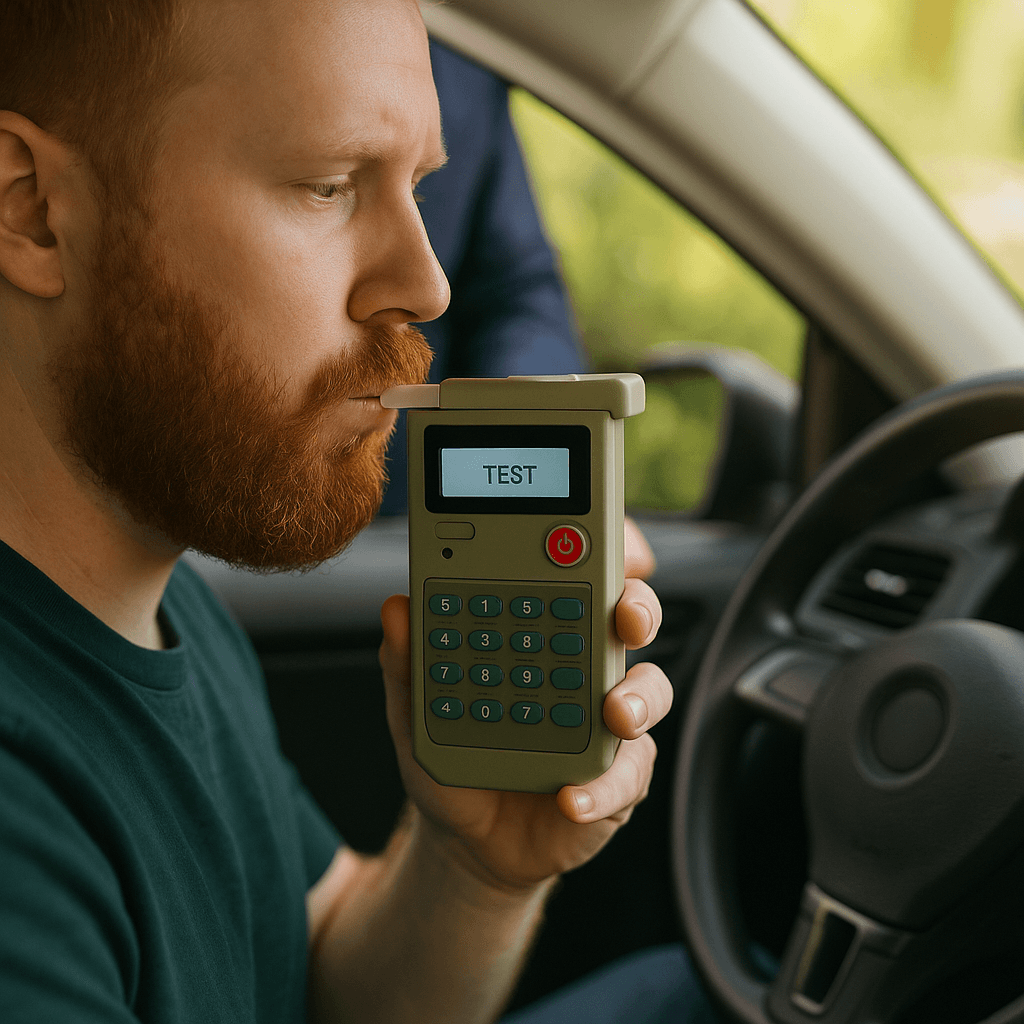
You select an installer from your state's approved provider list — every state maintains a roster of certified IID vendors, typically 3-8 companies per state. You schedule installation. Appointment lead times vary: urban areas typically offer 2-4 day windows, rural counties may require 7-10 days. The installer mounts the device, calibrates the breath sensor, programs the lockout settings per state specification, and trains you on the rolling retest protocol.
After installation, the device enters a monitoring enrollment period. The installer submits your installation record to the monitoring service (LifeSafer, Intoxalock, Smart Start, Draeger, Guardian Interlock, or whichever vendor your state contracts with). The monitoring service transmits your enrollment to the state DMV or monitoring authority. Processing time: 1-3 business days in most states, up to 5 business days in states with manual review queues like Michigan and Illinois.
Only after the state database reflects active IID enrollment does the DMV clear your record for restricted credential issuance. Some states mail the physical license automatically once the system updates (California, Oregon, Washington). Others require you to visit a DMV office with the approval order and proof of IID installation to receive the credential in person (Texas, Wisconsin, Ohio). Verify your state's protocol in the approval order itself — the document typically specifies next steps.
Compare car insurance rates in your state
Get quotes from licensed carriers — no obligation, no spam, results in minutes.
Get Your Free Quote✓ No Obligation Required✓ Licensed Carriers Only✓ Available Nationwide✓ Free to Compare
State-Specific Activation Windows and Physical Credential Issuance Paths
Texas issues occupational licenses in person at county DMV offices after IID activation confirms. Bring the court order, IID installation receipt, SR-22 filing confirmation, and proof of financial responsibility. Processing at the counter takes 15-30 minutes once your record clears. The occupational license is valid for the period stated in the court order, typically matching the underlying suspension duration or 1-2 years, whichever is shorter.
California mails restricted licenses automatically 5-10 business days after IID enrollment confirms in the state database. You do not visit a DMV office unless the approval order specifies an in-person requirement (rare). The restricted license lists the IID condition and approved driving purposes on the face of the card. Activation confirmation timing: LifeSafer and Intoxalock typically transmit enrollment within 24-48 hours; Smart Start and Draeger within 2-3 business days.
Florida issues Business Purpose Only licenses through the driver license office after IID installation and FR-44 filing both confirm. You must schedule a DHSMV office appointment — walk-ins are not accepted in most counties. Bring the administrative review order, IID installation certificate, FR-44 certificate of insurance, reinstatement fee payment receipt ($45 for most suspensions, $75 for DUI-related), and two forms of residency documentation. The BPO license is valid for the suspension period or until the next review date, whichever is sooner.
Wisconsin, Ohio, Pennsylvania, and other occupational license states require in-person issuance after IID activation and SR-22 filing confirm. Appointment lead times vary by county: urban DMV offices typically offer same-week appointments, rural offices may require 2-3 weeks. Bring all documentation listed in your approval order — missing any single item voids the appointment and resets the queue.
How to Avoid the Most Common IID Activation Delays
Installer scheduling delays account for 40-60% of extended activation timelines. Most installers operate appointment-based schedules with limited daily capacity. Urban areas with multiple provider locations offer shorter lead times; counties served by a single installer or mobile-only service frequently show 7-14 day waits. Call the installer the same day you receive your approval order — waiting 3-4 days to schedule commonly adds a full week to your total timeline.
Vehicle access issues delay installation when the approval order names a vehicle you do not own or cannot produce for the appointment. Some states require the IID be installed in the vehicle listed on your insurance policy; others allow installation in any vehicle you will operate. Verify the requirement in your approval order. If you plan to use a family member's vehicle, confirm they will allow IID installation and provide written consent if required — some installers refuse installation without registered owner authorization.
Monitoring service enrollment transmission delays occur when installer-submitted records contain errors: misspelled name, incorrect driver license number, wrong state monitoring program code. The state database rejects the enrollment record and the monitoring service must resubmit corrected data, adding 3-5 business days. Verify all information on the installation receipt before leaving the installer's location. Incorrect data is the installer's responsibility to fix, but you absorb the delay.
DMV database update lag varies by state and by time of month. End-of-month processing in California, Texas, and Florida commonly extends confirmation windows by 2-4 business days due to higher reinstatement volumes. If your IID installation occurs in the final week of the month, expect the longer end of the confirmation range. Some drivers call the DMV monitoring unit directly 3-4 business days post-installation to confirm enrollment visibility — this does not speed processing but provides certainty about whether the record transmitted successfully.
What Driving Is Legal Between Approval and Credential Issuance
No driving is legal until you possess the physical hardship credential and the IID is active in the vehicle you are operating. The approval order authorizes restricted driving once all conditions are satisfied — it is not itself a driving credential. Every state treats driving on an approval order alone, before IID activation and physical license issuance, as driving while suspended.
This creates a practical problem: you need the vehicle to install the IID, but you cannot legally drive the vehicle to the installer without the physical credential. Solutions vary by state. Some states allow a non-restricted licensed driver to accompany you and operate the vehicle to the installation appointment. Others require you arrange mobile installation at your residence or workplace, eliminating the need to drive the vehicle anywhere. A few states issue a temporary authorization to drive for IID installation purposes only — verify whether your approval order includes this language.
After installation, the IID is active in the vehicle but your driving record is not yet updated. You still cannot legally drive until the DMV issues the physical credential. The device will allow the vehicle to start (assuming you pass the breath test), but law enforcement checking your license status will see an active suspension with no restricted credential on file. This produces an arrest for driving while suspended even if the IID is installed and functioning.
The legal window opens only after three conditions align: IID installed and active, DMV database updated with monitoring enrollment, physical hardship credential in your possession. Until all three are true, no driving. Plan alternate transportation for work, appointments, and errands during the 7-14 day gap between approval and credential issuance — losing the hardship approval for a premature drive is not recoverable in most states.
How SR-22 or FR-44 Filing Timing Affects the Sequence
Most hardship license approvals require proof of financial responsibility before credential issuance — typically an SR-22 certificate filed with the state DMV by your insurance carrier. The SR-22 requirement runs parallel to the IID requirement: both must confirm in the state database before the DMV will issue the physical credential.
SR-22 filing takes 1-3 business days after your carrier submits the certificate electronically. Some states process SR-22s same-day; others batch-process weekly. If you secure SR-22 coverage the same day you receive your approval order but delay IID installation by a week, the SR-22 will already be on file when IID activation confirms — no additional wait. If you install the IID immediately but delay securing SR-22 coverage, IID activation will confirm but the DMV will still withhold the credential until the SR-22 posts.
Florida and Virginia require FR-44 certificates for DUI-related hardship approvals — a higher liability coverage mandate than standard SR-22. FR-44 processing follows the same timeline as SR-22 but requires carriers certified to write FR-44 policies, a smaller provider pool than SR-22. Securing FR-44 coverage in rural Florida counties sometimes requires 3-5 business days due to limited carrier availability; factor this into your timeline.
The optimal sequence: secure SR-22 or FR-44 coverage the same day you receive your hardship approval, then schedule IID installation for the earliest available appointment. Both requirements will be processing in parallel, minimizing total elapsed time to credential issuance. Stacking them sequentially — waiting for SR-22 confirmation before scheduling IID installation, or vice versa — adds unnecessary weeks.
What to Do If IID Activation Confirms But DMV Does Not Issue the Credential
Database sync failures occur in 5-10% of IID enrollments. The monitoring service transmits your activation record to the state but the DMV database does not update, leaving your record showing an active suspension with no IID enrollment visible. This produces a credential issuance denial even though the device is installed and active.
First step: contact the IID monitoring service (the number is on your installation receipt and on the device itself) and request confirmation that your enrollment transmitted to the state. The monitoring service can provide the transmission date, the state program code used, and whether the state database returned an acceptance or rejection code. If the transmission failed or was rejected, the monitoring service must resubmit — this adds 2-3 business days.
Second step: if the monitoring service confirms successful transmission but the DMV still shows no record, contact the state DMV monitoring unit directly (not the general DMV phone line — the approval order typically lists the monitoring unit's direct number). Provide your driver license number, the IID installation date, and the monitoring service name. The DMV can manually query the monitoring database and force a record sync if the enrollment exists but did not post to your driving record automatically.
Third step: if manual sync fails, request a monitoring enrollment verification letter from the IID provider. This is a signed document confirming device installation, activation date, and ongoing monitoring enrollment. Some states accept this letter as proof of compliance and will issue the hardship credential based on the letter while the database issue is resolved. Others require the database itself to update before credential issuance — no workaround exists in those states.
Resolution timelines vary. Simple sync failures typically resolve in 2-3 business days once identified. Data mismatch errors (incorrect driver license number, wrong monitoring program code) require the monitoring service to submit a corrected record, adding 3-5 business days. Unresolved database issues lasting more than 10 business days warrant contacting the court or DMV office that issued your approval order — they can intervene with the monitoring unit directly.