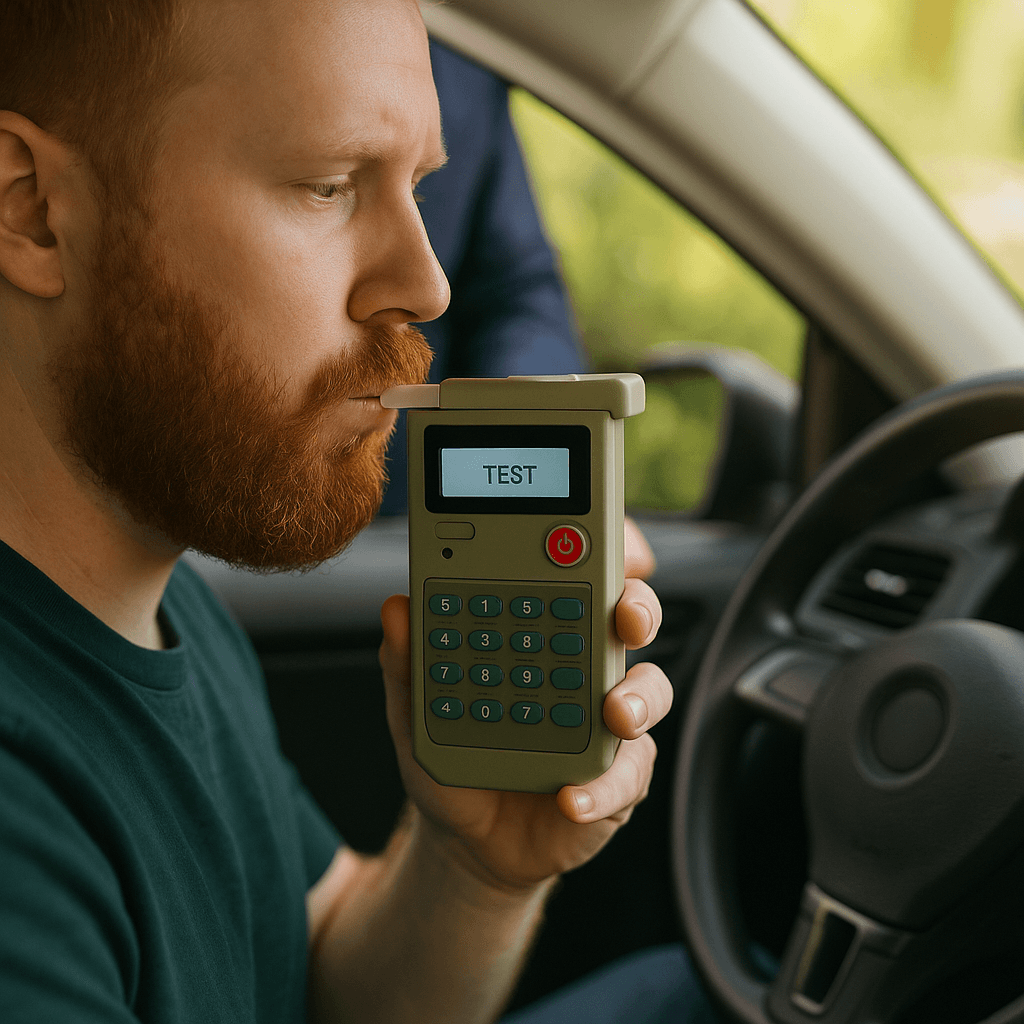
Your ignition interlock device transmits every failed test, lockout, and tamper attempt to the state DMV within 24 hours. Here's what triggers a report, how the data reaches your monitoring authority, and what happens when violations accumulate.
When Does the IID Actually Send Data to the State?
The ignition interlock device transmits violation data to your state's monitoring authority within 24 hours of the event. Every failed startup test, rolling retest failure, lockout, missed rolling retest, tamper attempt, and circumvention trigger gets logged in the device's internal memory and uploaded during the next scheduled transmission cycle.
Most modern IID units use wireless cellular transmission—your installer activates the modem during the calibration appointment, and the device begins reporting immediately. Some states still use download-only systems where technicians extract the data during monthly calibration appointments, but cellular reporting has become standard in 38 states as of current DMV requirements.
The transmission happens automatically. You don't trigger it, you don't authorize it, and you can't prevent it. The device operates as a continuous reporting instrument from the moment the installer activates it. If your hardship license approval requires IID installation, the monitoring period starts the day the device goes live, not the day your restricted license is issued.
What Events Trigger an Automatic State Report?
Failed startup tests above your state's threshold generate immediate violation flags. Most states set the fail threshold at 0.025% BAC, well below the 0.08% legal limit for standard driving. A single failed test doesn't always trigger a violation report—most states allow 1-2 failed tests per rolling 30-day period before flagging the account. The third failed test within 30 days typically generates an automatic notice to your monitoring authority.
Missed rolling retests count as violations in every state with hardship IID programs. The device prompts a rolling retest at random intervals while the vehicle is running, typically 5-15 minutes after startup and every 30-45 minutes thereafter. If you don't pull over and provide a breath sample within the grace period (usually 5-6 minutes), the device logs a missed retest and begins sounding the horn until you turn off the ignition. Every missed retest transmits to the state.
Tamper attempts, disconnection events, and power interruptions all trigger violation reports. The device monitors its own wiring and power supply continuously. If someone cuts the power cable, removes the handset, or attempts to bypass the system, the device logs the exact timestamp and duration of the interruption. Mechanics working on your vehicle can trigger false positives—most states allow you to document scheduled maintenance with your monitoring authority in advance to avoid violations.
Compare car insurance rates in your state
Get quotes from licensed carriers — no obligation, no spam, results in minutes.
Get Your Free Quote✓ No Obligation Required✓ Licensed Carriers Only✓ Available Nationwide✓ Free to Compare
How the State Receives and Processes IID Violation Data
Cellular IID units transmit encrypted violation data directly to the monitoring vendor's server. The vendor processes the data, flags events that meet your state's violation thresholds, and forwards flagged reports to the DMV or court-ordered monitoring authority within 24-48 hours. Your probation officer, hardship license program administrator, or DUI case manager receives a violation summary automatically.
Download-only systems require manual data extraction during monthly calibration appointments. The technician connects the device to a computer, downloads the stored event log, and uploads it to the monitoring vendor's portal. The vendor then processes the data and forwards violation flags to the state. This creates a reporting lag of up to 30 days—violations that occur early in the monitoring period may not reach the state until the next calibration.
Most states require the monitoring vendor to provide you with a copy of your violation report at each calibration appointment. You receive the same data the state receives: failed test counts, missed retest timestamps, tamper event logs, and total clean days. If you disagree with a flagged event, you must dispute it through your monitoring authority within 10-15 days in most states. The vendor does not adjudicate disputes—only the DMV or court can remove a violation from your record.
What Happens When Violations Accumulate on Your Record
Most states allow 2-3 minor violations during the hardship license IID monitoring period before taking action. Minor violations typically include isolated failed tests below 0.08%, single missed retests explained by emergency circumstances, or brief power interruptions during documented vehicle maintenance. The state reviews your full violation log at scheduled checkpoints—usually 90 days, 6 months, and 1 year into the monitoring period.
Major violations trigger immediate hardship license suspension or revocation in most states. A failed test above 0.08% BAC, multiple failed tests within 7 days, repeated missed retests, or tamper attempts almost always result in automatic license suspension. Your monitoring authority sends a suspension notice within 10 days of receiving the violation report, and your hardship license becomes invalid immediately—continuing to drive creates an unlicensed driving charge.
Violation-triggered suspensions typically add 90 days to 6 months to your original hardship license monitoring period. Some states restart the entire IID monitoring clock from zero after a major violation. Texas restarts the full 1-year occupational license IID period after any failed test above 0.08%. Wisconsin adds 6 months to the original monitoring period for each major violation. Florida revokes business purposes only licenses permanently after two major violations within the monitoring period and closes hardship eligibility for 5 years.
Can You See the Same Data the State Sees?
You receive a printed violation summary at every monthly calibration appointment. The summary includes total failed tests, missed retests, tamper events, clean days, and any flagged violations transmitted to the state since your last appointment. Most monitoring vendors also provide online portal access where you can view real-time violation counts and upcoming calibration due dates.
The raw event log contains far more detail than the summary you receive. The full log records every breath sample result (pass or fail), every rolling retest prompt and response time, every power interruption longer than 10 seconds, and every GPS coordinate if your device includes location tracking. Most states do not provide drivers with access to the raw log—only the processed violation summary.
If you suspect the device is malfunctioning or reporting false violations, request a device accuracy test during your next calibration. The technician can run a diagnostic test using certified alcohol simulators to verify the sensor is reading accurately. If the device fails the accuracy test, the monitoring vendor replaces it and you can dispute any violations logged during the malfunction period. The burden falls on you to prove the device was inaccurate—the state presumes all logged violations are valid unless you provide documentation proving otherwise.
How IID Reporting Affects Your Hardship License Insurance Requirement
States that require hardship licenses to carry ignition interlock also require continuous SR-22 insurance filing throughout the monitoring period. The SR-22 filing and IID monitoring run on parallel tracks—both must remain active for the full hardship license term. If your insurance lapses, the carrier notifies the DMV within 24 hours and your hardship license suspends automatically, even if your IID violation log is clean.
IID violations don't appear on your insurance record immediately, but they do affect your reinstatement timeline. If a major violation extends your IID monitoring period by 6 months, your SR-22 filing requirement extends by the same duration. Most states require the SR-22 to remain active until both the hardship license monitoring period ends and the underlying suspension is fully served.
Carriers do not have direct access to your IID violation log, but they do receive notice if your hardship license suspends due to IID violations. A mid-term license suspension for IID violations counts as a high-risk event and typically triggers a premium increase at your next renewal. Some carriers non-renew policies after multiple hardship license suspensions within a single policy term.