Most states require SR-22 filing on top of the hardship license application fee and ignition interlock installation — but the liability limits mandated for hardship approval often exceed your state's standard minimum, forcing a policy upgrade mid-suspension that catches drivers unprepared.
Why Hardship Approval Requires Higher Liability Limits Than Standard State Minimums
Your hardship license approval typically requires proof of liability coverage at limits higher than your state's standard minimum — not because of the ignition interlock device itself, but because courts and DMVs treat restricted licenses as higher-risk privileges requiring additional financial responsibility.
Texas illustrates this clearly: the state's standard minimum liability is 30/60/25, but occupational license petitions require 100/300/100 coverage in most counties. The interlock mandate runs parallel to this requirement, not instead of it. You need the higher liability limits, the SR-22 filing, the ignition interlock installation, and the court order — all four elements stack.
The practical shock comes when drivers budget for the interlock installation ($75-150 setup, $60-100/month monitoring) and the SR-22 filing fee ($25-50), then discover their current liability policy at state minimums won't satisfy the court's proof-of-insurance requirement. The policy upgrade from 30/60/25 to 100/300/100 often doubles the monthly premium before the SR-22 surcharge is even applied.
Which States Mandate Liability Upgrades for Hardship Licenses
Most states with formal hardship programs impose liability requirements above standard minimums, but the specific threshold varies widely. Illinois requires 50/100/20 for Restricted Driving Permits when the standard minimum is 25/50/20. Wisconsin's Occupational License program mandates 100/300/100 in most counties despite a 25/50/10 standard minimum. Georgia's Limited Driving Permit requires proof of coverage at 50/100/25 minimums when the state floor is 25/50/25.
Florida's Business Purpose Only license requires FR-44 filing — a coverage certification that mandates twice the state's standard liability minimums (100/300/50 instead of 10/20/10). Virginia applies the same FR-44 doubling rule for restricted licenses following DUI suspensions. The FR-44 filing itself encodes the higher liability floor; you cannot obtain FR-44 certification on a policy written at standard minimums.
A minority of states tie hardship liability requirements directly to the standard minimum without elevation. Oklahoma's Modified Driver License accepts proof of insurance at the 25/50/25 standard floor. Iowa's Temporary Restricted License similarly accepts standard-minimum coverage. The cost advantage is meaningful: maintaining 25/50/25 liability on an SR-22-stamped policy costs 30-50% less per month than upgrading to 100/300/100, even with identical filing surcharges applied.
Compare car insurance rates in your state
Get quotes from licensed carriers — no obligation, no spam, results in minutes.
Get Your Free Quote✓ No Obligation Required✓ Licensed Carriers Only✓ Available Nationwide✓ Free to Compare
How Ignition Interlock Requirements Interact With Liability Floors
The ignition interlock device requirement does not replace the liability upgrade mandate — the two run on separate regulatory tracks. Courts impose IID installation as a condition of restricted driving privilege; insurance regulators and underwriting departments set liability minimums as a condition of policy issuance for high-risk drivers.
When your hardship petition is approved with an IID condition, your insurance carrier must add an endorsement to your liability policy acknowledging the interlock restriction. This endorsement does not reduce your liability exposure or lower the required coverage limits. The carrier is certifying that you are insured while operating a vehicle equipped with an interlock — the policy still covers third-party claims at the limits stated, and those limits must meet the court's threshold for hardship approval.
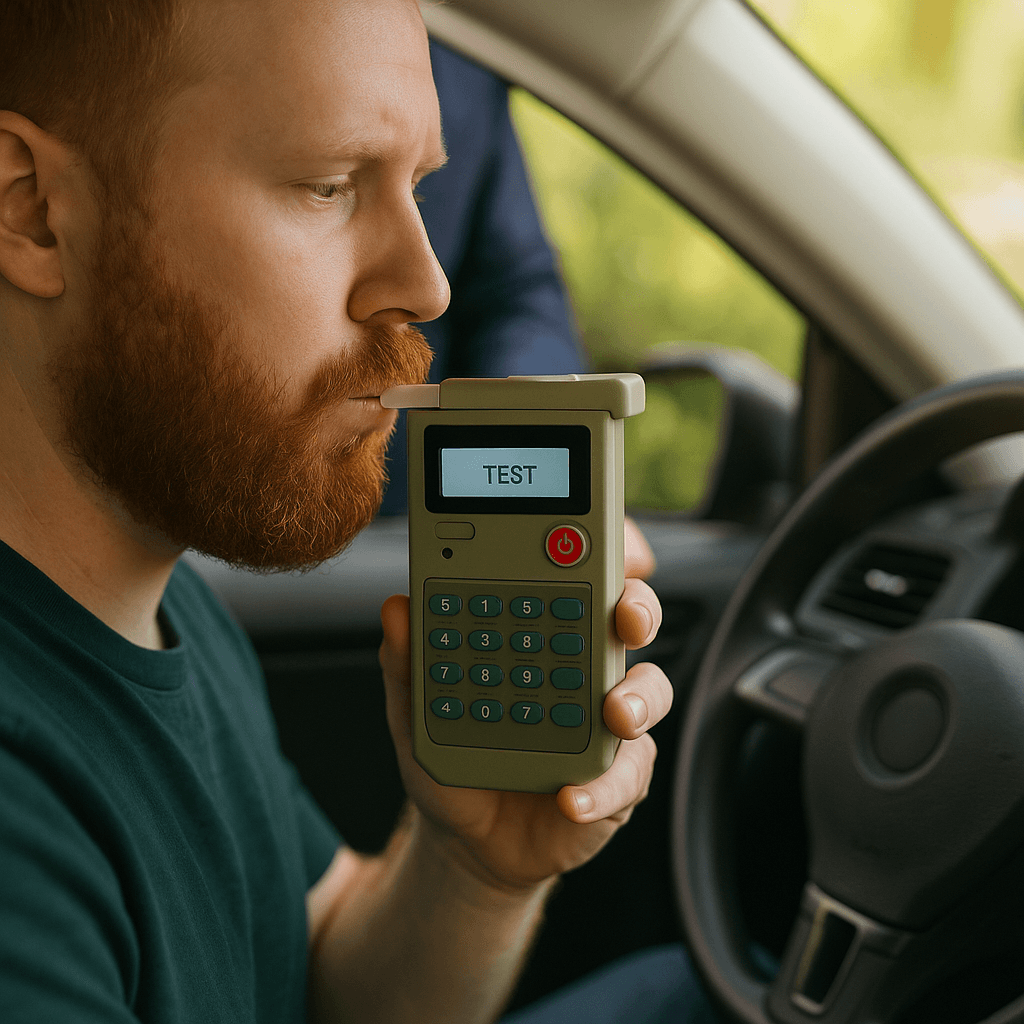
Some drivers assume the physical presence of the interlock device — which prevents operation if alcohol is detected — reduces the insurer's risk enough to justify lower liability limits. Underwriters do not price policies this way. The SR-22 filing and the elevated liability requirement reflect the suspension trigger and the legal classification of restricted driving, not the presence or absence of monitoring technology. The IID may reduce the likelihood of a future DUI, but it does not eliminate liability exposure from other collision or injury scenarios.
Cost Stacking: Application Fee, IID, SR-22, and Premium Increases
The full cost structure for a hardship license with ignition interlock includes at least four distinct charges. The hardship application fee ranges from $50 in states like Oklahoma to $300+ in California counties where court hearings are required. The ignition interlock installation runs $75-150 upfront, with monthly monitoring fees of $60-100 for the duration of the restriction period (typically 6-12 months minimum, sometimes matching the full SR-22 filing period of 3 years).
The SR-22 filing fee itself is a one-time carrier charge of $25-50 in most states, though some carriers fold this into the policy inception fee. The larger cost driver is the premium increase triggered by the SR-22 requirement combined with the liability upgrade. A driver previously paying $90/month for 30/60/25 liability might see that jump to $180-220/month for 100/300/100 liability with SR-22 certification — a $90-130 monthly increase that persists for the full filing period.
Over a 3-year SR-22 period with 12 months of interlock monitoring, the total stack might look like this: $200 application fee, $120 IID installation, $900 IID monitoring (12 months × $75), $50 SR-22 filing fee, and $3,240 in premium increases above the previous rate ($90/month × 36 months). That's $4,510 in direct suspension-related costs before accounting for attorney fees, DUI education program tuition, or reinstatement fees. Most of that cost is unavoidable if hardship driving is legally required for employment.
What Happens If You Apply With Insufficient Liability Coverage
Hardship petitions submitted with proof of insurance at standard state minimums are typically denied without prejudice — the court or DMV issues a deficiency notice identifying the liability shortfall and provides a window to resubmit with compliant coverage. In Texas, petitioners have 30 days from the deficiency notice to cure the insurance documentation gap before the petition is administratively closed. Illinois provides a similar 30-day cure period but counts the clock from the original filing date, not the deficiency notice date.
Some jurisdictions deny the petition outright and require a full new application with a second filing fee. Florida's DHSMV treats insufficient FR-44 documentation as a failed application; reapplication requires paying the full $65 administrative fee again. Georgia county courts applying Limited Driving Permit review similarly close deficient petitions and require new hearing dates, which can add 4-8 weeks to the approval timeline.
The compliance gap creates a Catch-22 for budget-constrained drivers: you cannot obtain the hardship license without proving higher liability coverage, but you may hesitate to pay the increased premium until you know the petition is approved. The safest sequence is to upgrade the liability policy and obtain SR-22 certification before filing the hardship petition, even though this means carrying the higher premium during the application review period (typically 2-6 weeks depending on jurisdiction). The alternative — waiting for approval before upgrading coverage — guarantees a deficiency notice and restarts the clock.
Non-Owner Policies and Hardship Liability Requirements
Drivers without vehicle ownership can satisfy hardship liability requirements through a non-owner SR-22 policy, but the same elevated liability minimums apply. A non-owner policy provides liability coverage when you operate vehicles you do not own — rentals, employer vehicles, or cars borrowed from family. Courts accept non-owner SR-22 policies as proof of financial responsibility for hardship license approval in nearly all states with formal restricted driving programs.
The cost advantage is meaningful. Non-owner liability at 100/300/100 limits with SR-22 certification typically costs $40-80/month, compared to $150-250/month for an owner policy covering a titled vehicle at the same limits. For drivers whose suspension followed an uninsured motorist violation or whose vehicle was totaled in the incident leading to suspension, the non-owner route cuts monthly insurance costs by 60-70% while maintaining legal compliance.
The restriction: non-owner policies do not cover vehicles titled in your name or regularly available for your use. If you live with a spouse who owns the vehicle you'll drive under the hardship license, the non-owner policy will not cover that vehicle. You must either be listed as a named insured on the owner policy (with SR-22 endorsement and elevated liability limits) or ensure the vehicle title is not in your name. Some families transfer title to avoid this conflict, but that creates its own complications if the restricted driver was the primary loan obligor.
How to Find Coverage That Meets Hardship Liability Floors
Not all carriers write policies at elevated liability limits for SR-22 or FR-44 filers. Standard-market insurers like State Farm and Allstate frequently decline to quote drivers with active SR-22 requirements, and those that do quote often apply surcharges that make the premium unaffordable. Non-standard carriers specializing in high-risk placements — Progressive, The General, Bristol West, Acceptance Insurance, National General — are more likely to issue policies at 100/300/100 limits with SR-22 certification, though pricing varies widely by state and violation history.
The comparison process matters: quoted premiums for identical coverage can vary by $60-120/month between carriers in the same ZIP code. A driver in Ohio comparing non-owner SR-22 policies at 100/300/100 limits might receive quotes ranging from $55/month to $175/month depending on carrier risk appetite and underwriting tier. The lowest quote is not always from the carrier with the weakest financial rating — rate structure differences reflect actuarial models, not solvency risk.
When comparing quotes, confirm three details explicitly: the liability limits match your state's hardship requirement (not just the standard minimum), the policy includes SR-22 or FR-44 filing as applicable, and the effective date aligns with your hardship petition filing timeline. Submitting a petition with an insurance declaration page showing coverage effective two weeks in the future will trigger a deficiency notice in most jurisdictions. The coverage must be active on the date of filing.