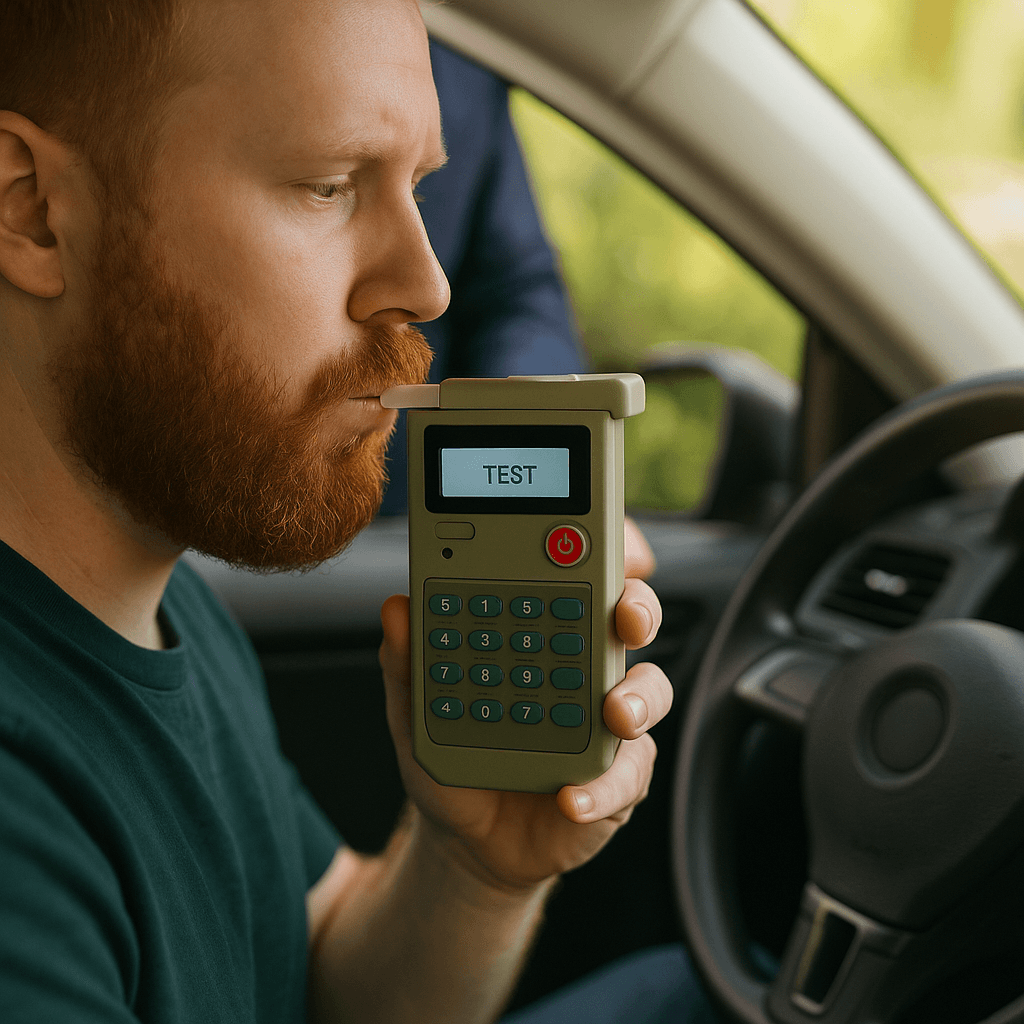
Carriers underwrite ignition interlock devices as physical damage exposures, not filing violations. Most suspend comprehensive and collision on IID-equipped vehicles unless the driver proves monitored-access control.
Why Comprehensive Coverage Disappears When IID Is Installed
Carriers withdraw comprehensive coverage on IID-equipped vehicles because the device creates a third-party access exposure. Someone other than the policyholder now holds mechanical control over ignition systems. Underwriters classify this as unmonitored driver risk until documentation proves otherwise.
The gap surfaces at quote. Most hardship license applicants assume SR-22 filing is the underwriting barrier. It is not. The ignition interlock device itself triggers a physical damage exclusion in 40 states where IID programs permit household members or employers to drive the vehicle under certain conditions. Carriers cannot verify who is blowing into the device at startup.
This explains why your premium quote included liability and SR-22 but excluded comprehensive and collision. The underwriter flagged the IID installation date from your DMV abstract and applied the physical damage restriction automatically. Reversing that restriction requires proof the device monitors every operator, not just the restricted driver.
What Carriers Actually Underwrite on Hardship License IID Cases
Underwriters evaluate three exposures when a hardship license includes an IID requirement. The first is the underlying violation that triggered suspension. DUI convictions produce 3-year SR-22 requirements in most states and place the driver in the high-risk tier for the full filing period. The second exposure is the restricted license itself, which limits driving to approved routes and times but does not reduce liability risk in the carrier's actuarial model.
The third exposure is device access. IID programs in 31 states allow household members to drive the vehicle if they provide a clean breath sample. Employers in 18 states can authorize other employees to operate company vehicles equipped with interlock devices under fleet exemptions. Carriers cannot distinguish between the restricted driver and an authorized secondary operator from claims data alone.
This is why comprehensive and collision disappear. The underwriter cannot price physical damage coverage when driver identity at the time of loss is unknowable. Liability remains in force because state law requires it and SR-22 certificates attest to it. Comprehensive does not carry the same mandate, so carriers exclude it rather than misprice it.
Compare car insurance rates in your state
Get quotes from licensed carriers — no obligation, no spam, results in minutes.
Get Your Free Quote✓ No Obligation Required✓ Licensed Carriers Only✓ Available Nationwide✓ Free to Compare
How to Restore Comprehensive Coverage While IID Is Active
Restoring comprehensive coverage requires proving monitored access to the underwriting team. Three documentation paths typically satisfy this standard. The first is an IID provider affidavit stating the device logs every startup attempt with timestamp, GPS coordinates, and photographic verification of the operator. Smart Start, Intoxalock, and LifeSafer all offer monitored-device affidavits for insurance underwriting purposes. Request the affidavit at installation and submit it with your SR-22 quote.
The second path is a single-driver household declaration. If you live alone and no other licensed drivers reside at your address, an underwriter may reinstate comprehensive after verifying household composition through DMV records and lease or mortgage documentation. This path works only when no co-titleholders appear on the vehicle registration.
The third path is employer fleet documentation. If your hardship license restricts driving to employment purposes and your employer owns the vehicle, the employer's commercial auto policy may extend comprehensive coverage to the IID-equipped vehicle under a scheduled driver endorsement. This requires the employer to add you as a named scheduled driver and accept the premium surcharge for the high-risk classification. Most small employers decline this option because the surcharge exceeds $1,200 annually in non-standard markets.
Why Collision Stays Excluded Even After SR-22 Is Filed
Collision coverage exclusions persist longer than comprehensive exclusions because collision losses correlate with restricted-license violations more strongly than theft or weather losses. Carriers review three years of claims data showing drivers on hardship licenses after DUI convictions file collision claims at 2.8 times the rate of standard drivers in the same rating territory. The IID does not prevent crashes. It prevents intoxicated operation, which is a subset of collision causes.
Underwriters also exclude collision because hardship license restrictions create timing gaps. Your hardship license may authorize driving Monday through Friday from 6 a.m. to 6 p.m. for work purposes only. If you file a collision claim on Saturday at 8 p.m., the carrier will deny the claim because you were operating outside your restriction window. Physical damage policies require lawful operation at the time of loss. Driving outside your hardship restriction makes operation unlawful even if the vehicle is insured.
Some non-standard carriers offer restricted collision coverage with time-of-loss exclusions written into the policy. These endorsements cover collision losses that occur during approved driving windows only. The premium is 40 to 60 percent lower than standard collision coverage because the exposure window is smaller. MAPFRE, Dairyland, and Bristol West offer time-restricted collision in 22 states where hardship license programs are common.
What Happens to Comprehensive When Hardship Converts to Full Reinstatement
Comprehensive coverage does not reinstate automatically when your hardship license converts to full reinstatement. The IID removal date and the SR-22 termination date govern underwriting separately. Most states require IID for 6 to 12 months after full license reinstatement. The comprehensive exclusion remains in effect until the device is removed and the removal is documented with the carrier.
You must notify your carrier within 30 days of IID removal and provide the removal affidavit from your device provider. The affidavit must include the removal date, final calibration report, and a statement that the device was returned or deactivated. Without this documentation, the underwriter assumes the device remains installed and the access exposure persists.
SR-22 termination follows a separate timeline. If your state required 3-year SR-22 filing after DUI conviction, the filing obligation continues for 3 years from the conviction date regardless of when your hardship license converted to full reinstatement. Comprehensive coverage reinstates when the IID is removed. Collision coverage reinstates when the SR-22 filing period ends and your driving record shows no additional violations during the filing period. These are distinct underwriting gates with distinct timelines.
Cost Difference Between Liability-Only and Comprehensive During IID Period
Liability-only SR-22 policies during IID periods cost $140 to $210 per month in non-standard markets, depending on state minimum liability limits and the underlying violation. Adding comprehensive coverage when the carrier permits it increases the monthly premium by $35 to $60 for vehicles valued under $15,000. Vehicles valued above $15,000 see comprehensive premiums of $60 to $95 monthly because the physical damage exposure scales with vehicle value.
Most hardship license holders cannot justify comprehensive coverage during the IID period. The device itself costs $70 to $100 monthly for lease and monitoring. Adding $50 monthly for comprehensive coverage on a $10,000 vehicle creates a $600 annual cost to protect against comprehensive losses. Theft, vandalism, and weather claims on vehicles driven under hardship restrictions are rare because the restricted route and time windows reduce exposure to high-theft areas and late-night vandalism.
Collision coverage during IID periods costs $90 to $150 monthly in non-standard markets with $1,000 deductibles. The annual cost exceeds $1,000 for coverage that excludes losses occurring outside approved driving windows. Most drivers wait until full reinstatement and IID removal to add collision coverage. SR-22 insurance costs focus on meeting the state filing requirement at the lowest sustainable premium, not on comprehensive physical damage protection.